
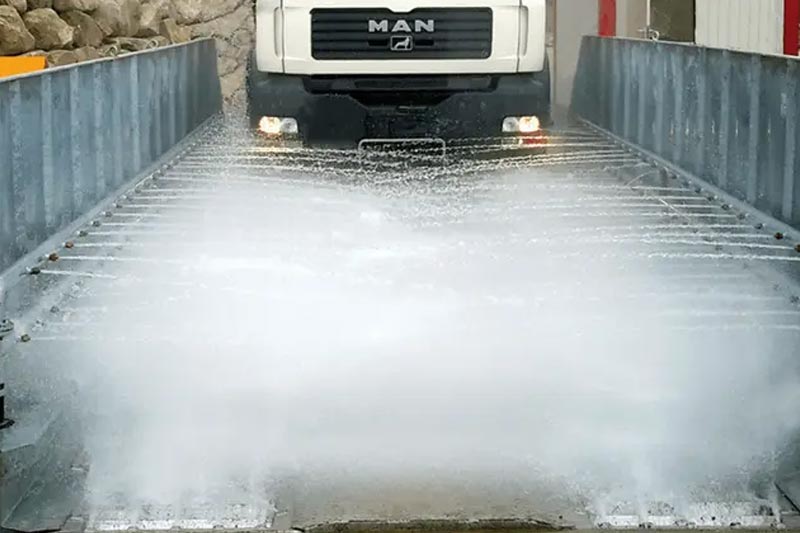
Unique spray pattern
Washes & rinses
Submersible pumps
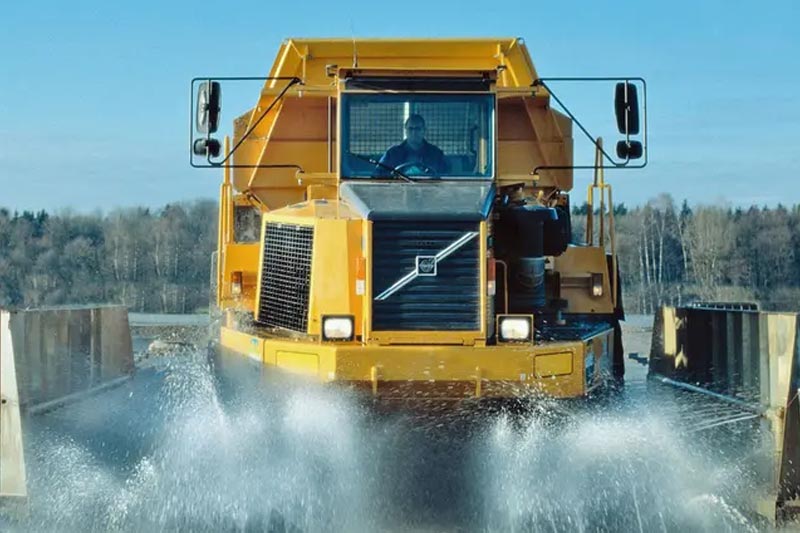
Washing technology
Tests using different water pressures, nozzle shapes, nozzle sizes, and spray angles have shown that large volumes of water at low pressure deliver the best results. High volumes of water at high pressure would naturally clean more aggressively, but only marginally — while energy consumption increases exponentially.
The best performance is achieved with a strong jet (at least 6 mm in diameter) at low pressure (the jet does not change direction between the nozzle outlet and the point where it hits the tires or chassis). Compared to a thin high‑pressure jet, it is less affected by air resistance and transfers its full kinetic energy to the contact point on the vehicle. To achieve this result, special “MobyPump” submersible pumps developed by Frutiger are used. When connected in series, they maintain a low inlet flow rate.
Water recycling
The robust submersible pumps do not require clean water to operate. The water can be slightly turbid and still clean the wheels effectively. The goal is a clean road, not a shiny vehicle. To achieve the required water quality, intelligent combined recycling tanks with baffle walls and overflow sections are used. After the washing process, the water in the tanks is treated through sedimentation.
The tanks can be adapted to the available space. If desired, the system can also be configured for clay removal, for example using a chain conveyor. In general, it is preferred to avoid additional equipment for separating clay and water, such as lamella clarifiers or cyclone separators. This is due to significant drawbacks, including acquisition costs, maintenance requirements, winter operation challenges, sludge removal, and other factors.
Need info about the products?
Contact our sales team for more information.